Gunfight at the Hope and Anchor – March 1858
The title of this note is what in modern parlance is called click-bait. Something written to get attention. There was no gunfight. However, there was a gun; there was a fight; and it does feature the Hope and Anchor Inn. So, to paraphrase Eric Morecombe in his comment to Andre Previn – the words are all there but not necessarily in the correct order.
The story involves a Coastguard Officer and four local men. It is a true story taken from several different newspaper reports issued in 1858.
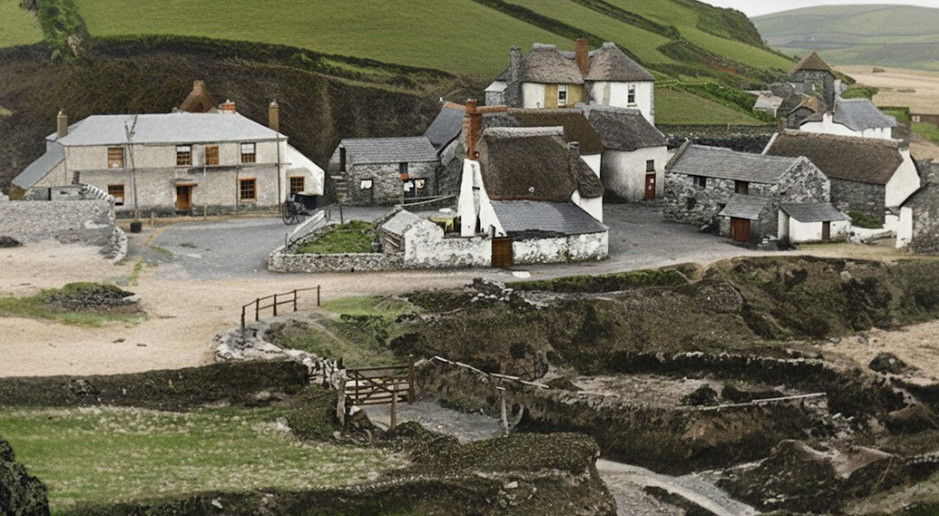
This picture taken in 1863 shows the scene of the incident as it was pretty much at the time of the event. The Hope and Anchor is on the left; Bridge Cottage is the thatched house in the centre obscuring “The Bird in Hand”; The Cabin and the Coastguard Houses are just out of view on the right; The Pound is on the bottom right.
Nicholas Blank was a Tailor and his wife was a dressmaker. He had been the Landlord of the Hope and Anchor through much of the 1850s. Adam Chapman at the time of the incident was Landlord of The Hope and Anchor Inn. John Hamblin was Landlord of The Bird in Hand. Isaac Jarvis was a fisherman and Labourer. In those days one earned money wherever possible.
The census around that time did not always give a house name but each entry had a number. From those numbers we can safely surmise that they all lived close by in the square at Hope Cove. The two pubs – The Hope and Anchor and The Bird in Hand, and two houses, The Cabin and Bridge Cottage. Living so close together in a small village they clearly knew each other well and were friends.
In February 1858 Lieutenant George William Yates– a local Coastguard – was on patrol around Hope Cove. At that time Hope Cove had its own resident Coastguard unit who were resident in the village. They were different from the force we know from the days of the 1900’s. In 1855 Walter White wrote about two pleasant hours spent in the Coastguard lookout on the Shippen and noted their impressive assemblage of pistols and cutlasses. They were armed men involved in law enforcement.
Yates came across Nicholas Blank who was carrying a sack. Yates demanded to see the contents and ordered one of his men to take a look. Blank would not allow him to search the bag and used abusive language, and said if he wanted to look inside, he would have to follow him. Yates pointed out that his refusal could make him liable to a fine. He took him before his Captain and Blank thereupon said he was sorry, and Yates said that he was satisfied. However, there was another issue in that Yates had put his donkey to pound, and Blank had had to pay 10d. to get it out.
It probably left a bad feeling within the village. The three men, Blank, Jarvis, and Hamblin met up at the Hope and Anchor. Blank told his tale and Jarvis said he had done a day’s work for Yates and had not been paid the 1/9d he was owed. With the recent incident fresh in their minds. They discussed the matter thoroughly. He had called at Yate’s house at 6 o’clock and Yates had said if Jarvis called in the morning he would pay him.
Getting agitated Jarvis decided to try again. At eight o’clock, along with Blank he renewed his visit to the nearby Coastguard Houses to try again to get his money. The response was much the same so they went back to the Hope and Anchor.
The unpaid 1/9d was still the topic of conversation and clearly feelings were getting stronger. The men made it clear that despite drinking since 6 o’clock they were all perfectly sober. Jarvis said he wished Yates was there because he would knock the damned fellow’s brains out. Chapman, as Landlord, tried to calm him down. The next step was for Jarvis to give Blank permission to collect the 1/9d for him and being unable to write asked Hamlin to write an authorisation which he signed.
It was a dark night and at 10:30pm Blank knocked at the back door of Yates’ House. He went to the back door because it was not customary for people of the place to go to the front door. He claimed he knocked gently and Yates answered in a condition described as “en dishabille”, as if he had just got out of bed. He had on him brace of government pistols and a dirk. There was no candle illuminating the scene. . Blank said he asked politely for the 1/9d owed to Jarvis. Yates told him to go away and immediately drew out a pistol. He warned him he would use it if he did not go away. He said Blank should be ashamed of himself coming at that time of night and getting him out of bed. He said he was a better man than Blank. Yates claimed Blank rushed at him and took him by the throat. Yates said “let me go or I will strike you with my pistol.” He pulled the trigger but the gun just fizzed and failed to go off. He then beat Blank about the head several times with the gun completely knocking him out. He ordered the Chief Boatman to take care of him. The boatman said he found Blank leaning against a wall having lost much blood. He said Blank said he said he had been shot, and was a murdered man. There were marks of struggling on the gravel.
The next thing Blank knew he was lying in The Hope and Anchor and people were bathing his face.
The next day Yates reported himself to his superior, Captain Herbert. He confessed Blank had asked for money but he refused because he didn’t owe him any and as he wouldn’t go away he drew his pistol. He said Blank had gone there just to insult him. He grabbed him by the collar and there was a scuffle. Fearing for his safety he beat Blank with his pistol several times.
Newspapers reports of the incident are a bit jumbled up but the account above uses what seems to be an accurate account. The information draws from the resulting court case and the prosecution of Yates.
Whatever the full truth of the matter it is interesting to see the prevailing attitudes. One report describes Yates appearing as a smart senior customs officer whereas the other actors in this event were mere working men spending a long evening in the pub. At the summing up the Judge asked the jury to bear in mind that a custodial sentence on Yates would do great damage to his reputation and career prospects. He dismissed the jury to consider their verdict.
They returned in just a few minutes and despite the fact that Yates had admitted beating Blank senseless they found him “Not Guilty”.
His career may well have been intact but there would surely have been ill feeling within the village. After two months Yates was transferred to a Coastguard Station some distance away.
